
We’re drowning in decisions we never made.
Game of Thrones was never really about dragons or iron thrones. It was about power — who holds it, who hunts it, who destroys everything to get it. And beneath all the scheming and slaughter, one question pulsed through every season: Who gets to decide what matters?
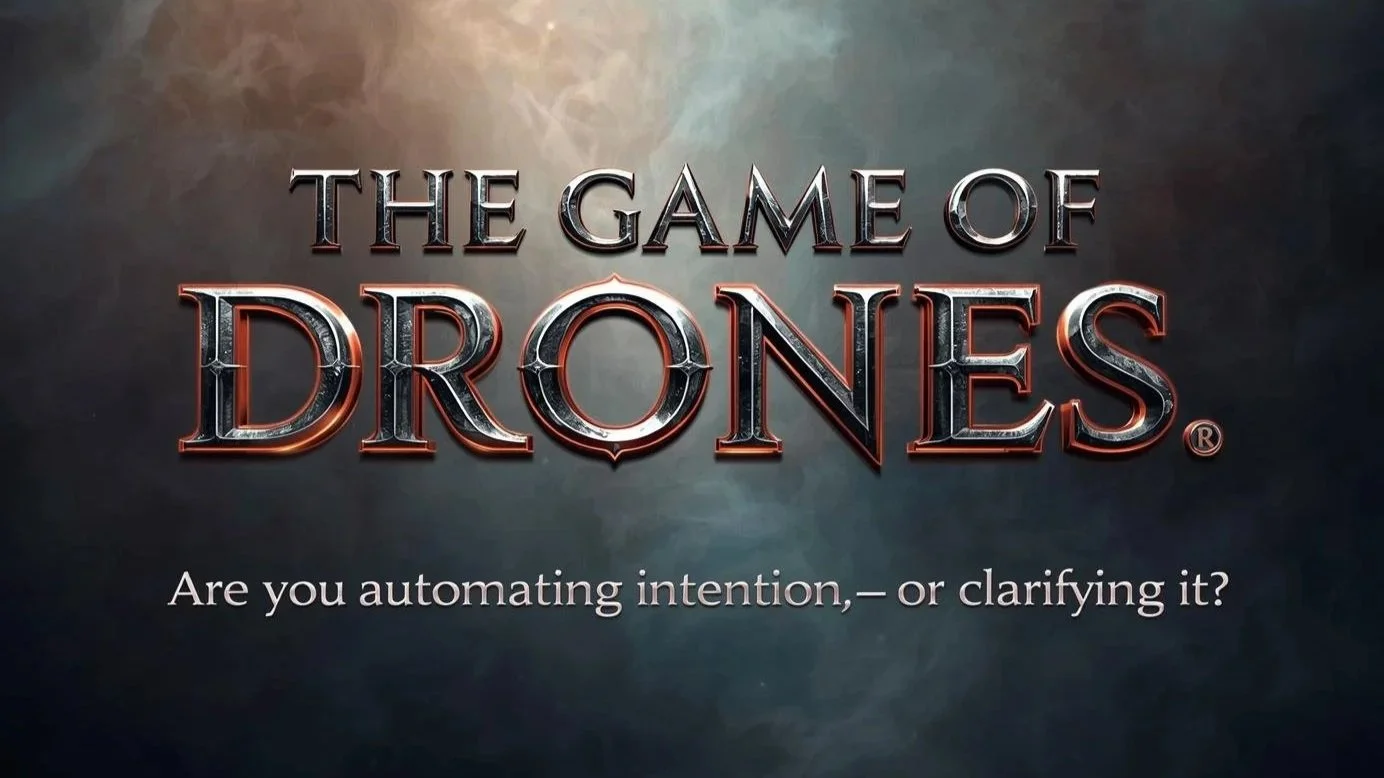
Now we're living our own version. Call it The Game of Drones. The houses aren't Stark or Lannister — they're Google, OpenAI, Meta, Anthropic. The iron throne isn't a physical seat. It's attention, agency, and meaning itself. And the question remains the same: Who decides what matters? Except this time, we might not be the ones answering.
The Houses
Three empires are rising, each with their own vision of the future we're building together.
House Silicon operates under the motto "Move fast and automate everything." Their goal is efficiency, scale, and the elimination of friction — including human thought. Their weapons are algorithmic persuasion, infinite content, and seamless automation that makes everything feel effortless until you realize you've stopped choosing.
House Human counters with "Slow down and make sense." They're fighting for intention, meaning, connection, and consequence. Their weapons are clarity, creativity, belief, and purpose — the things that can't be optimized or automated without losing what makes them valuable.
House Ambition believes "Whoever builds the best tool wins." They're pursuing power through capability itself, wielding AGI development, alignment debates, and existential promises about what technology could become. They're not concerned with the philosophical questions — they're racing to build the future first and asking questions later.
Three houses. One throne. And billions of people caught in the middle, trying to figure out which side they're on, or whether they're even in the fight at all.
The Real Threat
In Game of Thrones, the real enemy wasn't any single house competing for power. It was the White Walkers — the existential threat everyone ignored while they fought over the throne. In the Game of Drones, the real enemy isn't AI itself. It's our willingness to hand over the work of being human.
AI doesn't strip away intention. We do that ourselves by outsourcing clarity, creativity, and sense-making to systems that can generate answers but can't tell us what questions matter. AI doesn't erase meaning. We do that by choosing speed over depth, output over impact, noise over signal, volume over value.
The drones aren't coming to take over. They're filling the space we've already abandoned. We're not being conquered by some external force. We're abdicating, piece by piece, decision by decision. And that's far more dangerous than any dystopian AI takeover scenario, because it's happening quietly, comfortably, with our full permission.
What We're Fighting For
Here's what's actually at stake in this game, beyond the metaphors and the drama.
We're fighting for the ability to create work that matters to us. Not work that an algorithm suggests based on engagement metrics. Not work optimized for reach or virality. Work that connects to something we actually care about, that reflects what we believe, that leaves us feeling like we contributed something meaningful to the world.
We're fighting for the capacity to make sense of our own lives. To pause long enough to think clearly. To ask the questions that matter: Why does this matter? What's actually at stake here? Who am I becoming through the choices I'm making? These aren't luxuries or philosophical indulgences — they're the foundation of living with intention instead of just reacting to whatever demands attention next.
We're fighting for the right to live with intention instead of distraction. To choose our own cause rather than having it chosen for us by whatever algorithm decides what we see, read, think about, and ultimately become. To feel the weight of consequence in our decisions. To carry something forward because it's ours, not because it was suggested to us.
This isn't anti-AI. It's pro-human. AI is a tool, and tools don't create meaning — they amplify what's already there. But if we've lost the practice of making meaning, if we've outsourced it, automated it, delegated it to systems that can generate content but can't tell us what's worth saying, then what exactly are we amplifying? An echo of nothing. A hollow efficiency in service of goals we never actually chose.
Winter Is Coming (But We're Not Helpless)
In Game of Thrones, the characters who survived weren't the strongest or the smartest. They were the ones who remembered what they were fighting for when everyone else lost the thread.
Jon Snow didn't win because he had the best army. He won because he never lost sight of the stakes — what would be lost if they failed, who they were protecting, why it mattered. Arya didn't survive because she was fearless. She survived because she held onto her identity when everyone else forgot theirs, when it would have been easier to become no one. Tyrion didn't outlast everyone through power or physical strength. He outlasted them through clarity — by seeing what others refused to see, by understanding what was really happening beneath the surface.
The Game of Drones follows the same logic. We don't win by rejecting AI or refusing to engage with new tools. We win by refusing to outsource our humanity. We win by building practices that keep us tethered to intention, creating work that reflects what we actually believe, and choosing meaning over efficiency when it actually matters. We win by teaching the next generation to think, not just prompt. By reclaiming the space between impulse and action, between question and answer, between stimulus and response.
AI can write the words, but it can't decide what's worth saying. It can generate the strategy, but it can't tell you what's at stake. It can optimize the process, but it can't make your work feel like it matters. It can create endless content, but it can't give you a reason to care. That's still ours — if we choose to keep it.
The Question
So here's the real question facing all of us: In the Game of Drones, which house are you fighting for?
Are you optimizing for output, or building for meaning? Are you automating intention, or clarifying it? Are you letting the algorithm decide what you see, think, and become, or are you choosing for yourself? Are you playing the game with intention, or letting the game play you without even realizing it's happening?
Winter is coming. The capacity for human agency, creativity, and meaning-making is up for grabs. The houses are mobilizing, each with their vision of what comes next. The question isn't which one will win — it's which one you're fighting for. And more importantly: Are you even in the fight?
Because the real tragedy isn't losing the game. It's not realizing you were playing.